New Publication: Medical Image Enhancement and Deblurring
In short: a paper on deblurring medical images, published at the NUSYS'19 conference . It combines anisotropic diffusion, shock filters and a coarse-to-fine blur kernel estimate to pull a sharp image…
- published
- read time
- 1 min
- words
- 213
- lang
- en
- filed under
- signal processingpapersFields of research
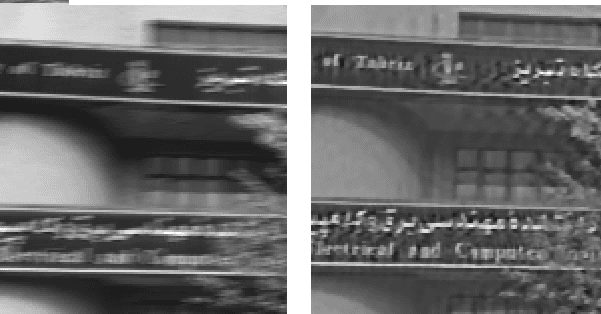
In short: a paper on deblurring medical images, published at the NUSYS'19 conference. It combines anisotropic diffusion, shock filters and a coarse-to-fine blur kernel estimate to pull a sharp image back out of a blurred one.
Abstract
One of the most common image artifacts is blurring. Blind methods have been developed to restore a clear image from blurred input. In this paper, we introduce a new method which optimizes previous works and adapted with medical images. Optimized non-linear anisotropic diffusion was used to reduce noise by choosing constants correctly. After de-noising, edge sharpening is done using shock filters. A novel enhanced method called Coherence-Enhancing shock filters helped us to have strong sharpened edges. To obtain a blur kernel, we used the coarse-to-fine method. In the last step, we used spatial prior before restoring the unblurred image. Experiments with images show that combining these methods may outperform previous image restoration techniques in order to obtain reliable accuracy.
Keywords: medical images, blind deconvolution, deblurring.
The blur model
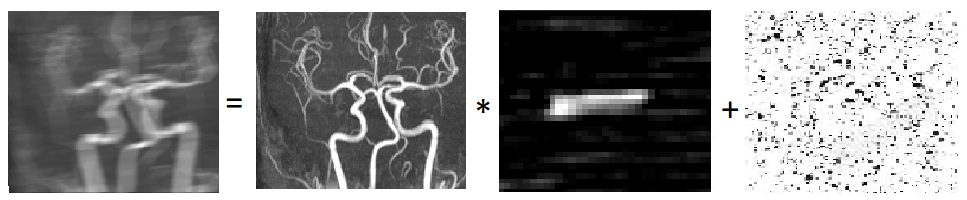
A blurred image is the convolution of the sharp image with a blur kernel, plus noise. The noise term is small but it matters a lot once you start inverting the convolution.
Read the paper on SpringerLink. It appears in LNEE'19 and on the IEEE website.
related